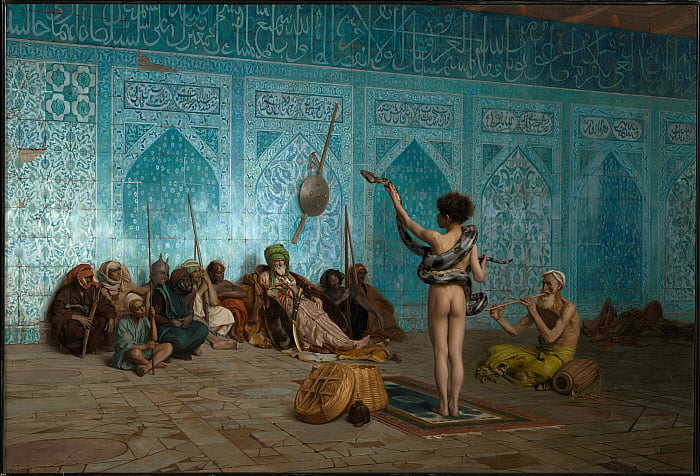
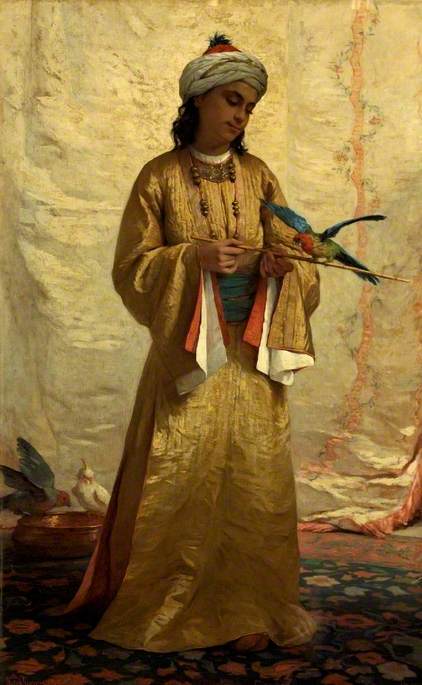
Orientalism is a category of art that refers to European depictions of Oriental (Eastern) subjects. Subjects often include areas including North Africa, the Middle East, and East Asia. This exhibit focuses on European depictions of the Middle East throughout history. While Orientalist works often were painted in a manner that appeared to document, they were very rarely neutral: often over-exoticising the Middle East, contributing to a reshaped Western perspective on "the East."
More recently, Orientalism has drawn criticism as being simplistic, stereotyped, and displaying inaccurate conceptions of Arab and Asian cultures ("Orientalism," Britannica). These works helped construct an 'imagined reality' for viewers: one catering towards European desire and politics. As scholar Edward Said argues, these distorted representations are a part of a broader system in which the west defines and controls how the Orient is perceived (Çelik 382).
The exotic nature of Oriental paintings manifests in hundreds of ways. For example, nudity is frequently used to suggest that it was a common occurrence in the historical Middle East, despite reality being on the contrary ("Orientalism," Smarthistory). This created a power structure which allowed 'othering' of middle eastern people on the basis of their geographic location through extreme depictions of their culture. Feminized, sexualized, and racialised paintings are common in Orientalist circles, which strongly distorted perception of consumers.
Orientalist artists were regularly displayed in public art exhibits, including at the Salon. The publicity forded to Orientalist artworks, thus, served a large part in shaping societal perspectives on the middle east. These mindsets were strongly in support of colonialism in the Middle East and North Africa ("Orientalism Art," Art in Context).
Although much of the artwork was historically inaccurate, studying Orientalism helps one understand the power dynamics that shaped colonialism. Furthermore, understanding Orientalism helps teach how historical viewpoints were altered, and allows us to contemplate how our mindsets are being shaped in the modern world through depictions given to us as reality. A thorough contemplation of Orientalist art reveals not only how historical biases were caused, but also an introspective feeling as to what biases shape our minds today.
As you explore the exhibit, keep in mind the power structure that shaped the images and granted them fame. Ask yourself questions like "what does this image make me try to feel," "what is being omitted," and "what is being purposefully included." Through doing that, you will realize how narratives were controlled surrounding the Middle East through art. By the end of the exhibit, you will have a glimpse into the colonialist mindset, and the narrative those in support of colonialism consumed.